
What Is a Chronograph Watch? Complete 2026 Guide
One of the most interesting mechanical complications ever invented is the chronograph watch; this watch is an ideal combination of engineering, functionality, history and daily utility. A chronograph watch is a watch that can be used to create time and to measure the lapsed time with ease with an in-built stopwatch. The name itself derives from the Greek word chronos (time) and graph (to write) which may be translated into a time-recording device.
But do you know what a chronograph watch does? How does a chronograph work? Or is it that you cannot seem to see the types of chronograph movements used in the best models nowadays?
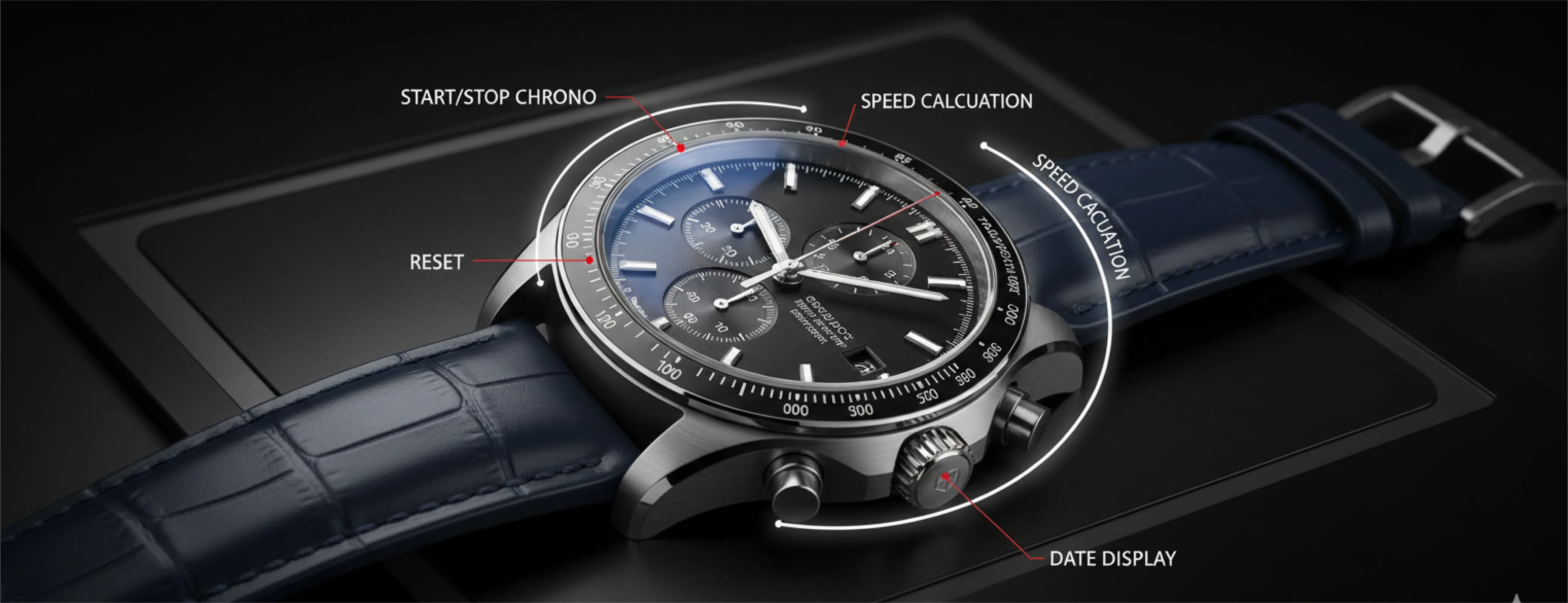
A chronograph offers three necessary skills:
- Start/stop elapsed time
- The stopwatch hand should be moved to zero.
- Measures elapsed minutes and hours via sub dials.
These actions are usually controlled by the two pushers, which are generally placed at 2 o’clock and 4 o’clock. The most glaring giveaway of a watch being a chronograph is the tall, sweeping seconds hand in the middle, which does not move until the timing mode is turned on.
Chronographs are favored due to their combination of style and functionality - a sports complication that remains acceptable even in the luxury dress.
How a Chronograph Watch Works (Mechanical vs Automatic)
A chronograph watch contains a second mechanism of gears attached to the base mechanism. Chronographs are more complex, delicate, and more costly than simple three-hand watches because of this stratified structure.
Upon pressing the start button:
- Cam switches position. A column wheel.
- The chronograph gear-train is switched in.
- The vibration is passed to the chronograph’s second hand.
- The subdials start tracking the time that has passed.
Press stop - the train is disengaged.
Press reset - hammers put all hands back to zero.
It is this game of switches, grips, and wheels that causes watch enthusiasts to talk about the chronographs as miniature engines.
Well-known chronograph movements in 2025:
- Rolex Caliber 4131- the engine with which the new Rolex Daytona is run, is also precise and efficient.
- Zenith El Primero - the first full automatic chronograph, making 36,000 vph.
- Valjoux/ETA 7750, a highly powerful, mythical movement, was used across the industry.
Quartz Chron Craft Technology
The quartz chronograph watch works otherwise. A microchip transmits pulses to a stepper motor, enabling precise timing (up to 1/100th of a second) with minimal maintenance. These are prevalent in sports watches due to their durability and accuracy.
Chronograph Subdials Explained: Bi-Compax vs Tri-Compax
Dials on chronographs often feature several sub-registers, and collectors rely on layout to identify a particular model.
Bi-Compax (2 subdials)
- Running seconds
- 30-minute counter
- Mature, old-fashioned symmetry.
- As with old Rolex Daytonas, such as the ref. 6263.
Tri-Compax (3 subdials)
- Running seconds
- 30-minute counter
- 12-hour counter
- The most recognized layout
- Worn in the Omega Speedmaster, AP Royal Oak Chronograph, and contemporary Daytonas.
Both variations alter the watch’s visual equilibrium and convenience, which is why collectors often prefer either.
The Four Main Types of Chronographs
Breton 2 Pusher Chronograph
The timeless design that is still reigning in watchmaking.
2025 icons:
- Rolex Cosmograph Daytona 126500LN
- Omega Moonwatch Professional Speedmaster.
- Breitling Navitimer B01
- Patek Philippe 5172G
These remain the most popular styles collection-wise, particularly the steel models.
Monopusher Chronograph
Single start/stop/reset button - classy and historic.
Modern favorites:
- Montblanc 1858 Monopusher
- Vacheron Constantin Cornes de Vache.
- Patek Philippe 5370P (monopusher-reset in split-seconds form, technically).
Collectors like this layout as it shows the history of chronographs in the early days.
Flyback Chronograph
One push to restart, immediately, good with pilots or at high speed -- high-speed timing.
Top models:
- Blancpain Air Command
- Longines Avigation BigEye
- Zenith Pilot Type 20
Flyback chronographs offer an active, thrilling time display.
Rattrapante (Split-Seconds) Chronograph
The most advanced and upscale. This is done using two central seconds hands, which can be used to time two events simultaneously.
High-end 2025 examples:
- Patek Philippe 5204R
- A. Lange & Sohne Double Split
- Rolex Daytona Ref. 6264 (an old grail) - John Player Special.
A rattrapante is regarded as one of the greatest works in mechanical timepieces.
Chronograph vs Chronometer – What is the Difference?
A common confusion:
- Chronograph = a time-telling feature.
- A chronometer is an authorized standard of accuracy.
A single watch can be both. Indeed, all contemporary Rolex Daytonas are chronographs and superlative chronometers.
Is a Chronograph Watch Worth Buying in 2026?
Yes -- for multiple reasons:
- Investment Value: Numerous chronographs have high appreciation potential. Case Study: Rolex Daytona 116500LN sold at an average of 14,500 and is currently trading over 28,000-32,000.
- Practical Utility: Despite the ubiquity of smartphones, a mechanical chronograph offers greater simplicity for cooking, gym use, meetings, aviation, and racing.
- Emotional and Mechanical Appeal: One of the most rewarding gestures in luxury horology is watching a column-wheel chronograph engage.
Real-World Uses for Chronographs in 2026
People do not just wear chronographs because of appearance. Common uses include:
- Timing laps on a racetrack
- Time of exercise intervals.
- Tracking parking meter time
- Surveillance of the surface of diving.
- Taking espresso shots (serious collectors do it constantly).
This combination of functionality and fashion makes chronographs far from redundant in 2025, even with sophisticated digital timekeeping devices.
FAQs
What is the primary purpose of a chronograph today?
Practical timing — workouts, races, navigation — and the enjoyment of using a mechanical tool instead of a smartphone.
Are quartz chronographs bad or low-value?
No. They’re highly accurate and durable, though mechanical chronographs are more collectible.
Which chronograph movement is considered the best?
The Rolex 4131, Zenith El Primero, and high-end Patek/AP/Lange calibers lead the industry in 2025.
Can I swim with my chronograph watch?
Only if it has at least 100m water resistance and you avoid pressing pushers underwater, unless the watch is designed for it.
Do chronographs cost more to service?
Yes — the extra gears and complications make servicing more expensive than standard watches.