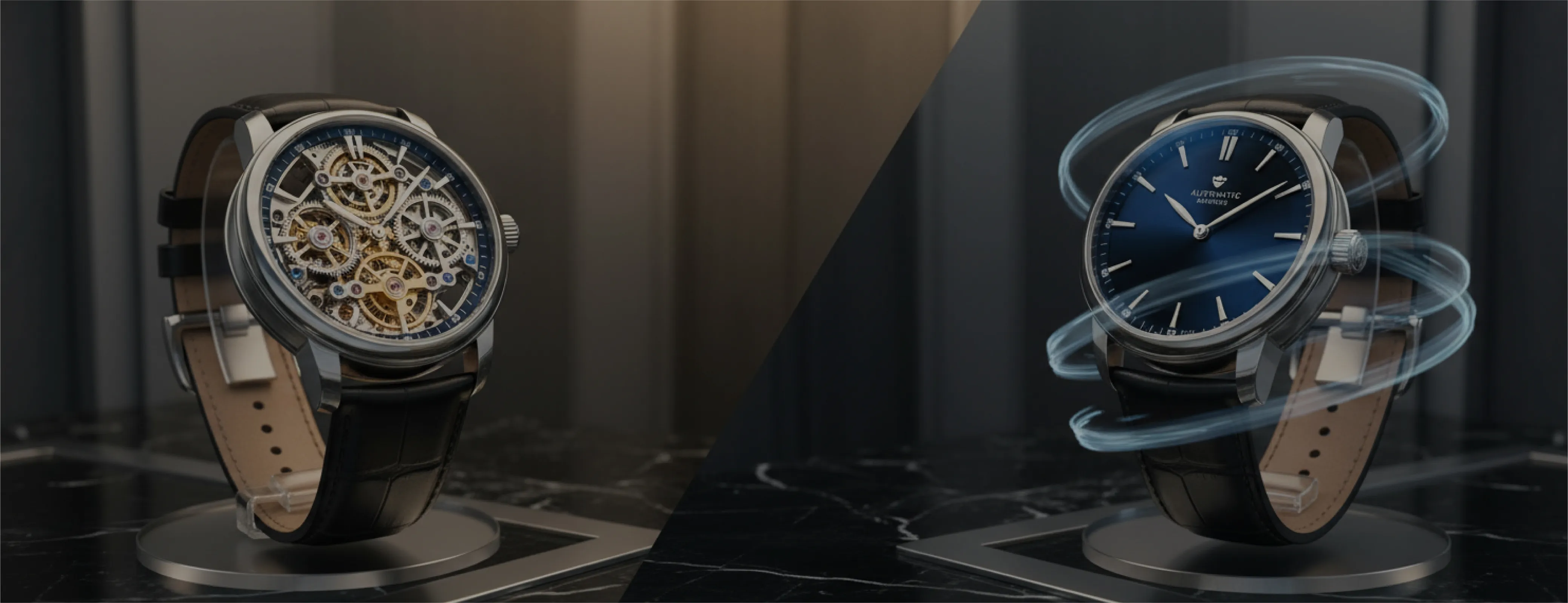

Mechanical vs Automatic Watches: Understanding the Key Differences
Two terms are commonly used in reference to mechanical watches, namely, automatic and manual wind. Although they both belong in the larger category of mechanical watches, the distinctions between the two are often confused by many individuals in the debate over mechanical vs automatic watches.
Remember - Luxury watches have always been fascinating to collectors and other fans, not just for their aesthetic value but also for the engineering that goes into their production.
The guide will cover the differences between mechanical and automatic watches, the pros and cons of each, and illustrate examples of the best brands in the industry - including Rolex, Omega, and Patek Philippe - to help you make an informed choice for your collection.
Understanding Mechanical Watches
Mechanical watches have a mainspring, a coiled metal spring that stores energy at their core. Mechanical watches, compared to quartz watches, which use batteries to keep time, draw on accumulated power and a complex system of gears and springs to maintain time. This complex process is the pride of Swiss horology, a tradition to which brands such as Rolex and Patek Philippe have honed their craft over decades.
Key Components of a Mechanical Watch
| Component | Function |
| Mainspring | Stored either by hand or by automatic means. |
| Gear Train | Pushes the force of the mainspring to the escapement. |
| Escapement | Controls the power that is released in the balance wheel. |
| Balance Wheel | Swings to keep the proper time. |
A further division of mechanical watches can be made between manual-wind mechanical watches and automatic watch movements, with unique features and experiences to use.
Manual Wind Watches
Also known as hand-wound watches, manual wind watches require regular winding via the crown. This is done to save energy in the mainspring that drives the watch.
Manual wind watches are often preferred by collectors who enjoy a tactile connection with their timepiece. The winding process generates a feeling of involvement and ritual such that every time one engages with the watch, it is not wasted.
Advantages of Manual Wind Watches
- Physical contact with the power source of the watch.
- Aerodynamic profile with no rotor.
- Develops the value of the practice of winding.
- Provides a historical affiliation to the very first mechanical watches.
Disadvantages
- Must be wound on a daily or regular basis.
- The possibility of overwinding should it be done sloppily.
- No longer suitable for the traveling or everyday user.
Example: There are vintage Rolex Oyster Perpetual models with hand-wound movements, which provide a collector's item in the selection of Rolex history before the standardization of Rolex on automatic calibers.
Automatic Watches: The Self-Winding Marvels
An automatic watch is also mechanical - but it winds the mainspring using a rotor as the wearer moves the wrist. This is the reason why the automatic watches are commonly referred to as self-winding watches.
Automatic watches blend the beauty of traditional watch-making with convenience - so they are appropriate to wear all day. Such brands as Rolex have optimized this mechanism and made sure that the precision is high, the service life is long, and the performance is long.
How Automatic Watches Work
- Rotor Movement: The semicircular rotor rotates with the movement of the wrist.
- Reverser Mechanism: Appends rotor movement to the winding of the mainspring.
- Power Reserve Maintenance: The watch is always charged as long as it is in its wear.
Advantages of Automatic Watches
- Automatised to wind itself.
- Power reserve, which is regularly used.
- Easy to use daily.
- Tend to be stronger to suit the modern lifestyle.
Disadvantages
- Slightly thicker than manual wind watches due to additional components
- The slight possibility of rotor noise.
- Needs to move to keep him/her energized.
Rolex Example: Modern Rolex automatic watches, including the Datejust, Submariner, and GMT-Master II, feature high-performance Oyster Perpetual movements with self-winding technology and precision certified by COSC standards.
Mechanical vs Automatic: Head-to-Head Comparison
| Feature | Manual Wind Watch | Automatic Watch |
| Winding Mechanism | Hand-wound via crown | Self-winding via rotor |
| Maintenance | Requires daily winding | Needs to be frequently worn to remain wound. |
| Thickness | Slim profile | Slightly thicker |
| Connection to Watch | Direct engagement | Indirect (by movement on the wrist). |
| Ideal For | Enthusiasts & collectors | Daily wearers, travelers |
| Iconic Examples | Patek Philippe Calatrava | Submariner, Seamaster, Rolex, Omega. |
This comparison shows that both categories of mechanical watches are great with craftsmanship, but they are less convenient, more general, and less interactive with the wearer.
Factors to Consider When Choosing
In choosing a mechanical and an automatic watch, a few factors should be involved to make the right choice:
Personal Lifestyle
Automatic watches are good when one is busy and puts the watch on every day.
Manual wind watches appeal to collectors or those who enjoy winding a watch as a personal ritual.
High regard for Craftsmanship.
Manual wind watches offer a more intimate connection to the mechanics, fostering a deeper appreciation for traditional horology.
The combination of reliability and craftsmanship is reflected through automatic watches, which display engineering innovation, including the Perpetual rotor system of Rolex.
Brand and Model Preferences
There are a lot of luxury mechanical watches that serve both. For instance, Rolex focuses almost entirely on automatic movements today, while Patek Philippe still produces high-end manual-wind watches.
The collectors might select certain models according to complication, beauty, and historical value.
Budget Considerations
The automatic watches are a little higher as they require extra components.
Manual wind watches can be more affordable in entry-level luxury but may command high value for vintage or rare models.
Investment & Longevity
Rolex mechanical watches maintain strong resale value due to global demand.
Manual wind watches, especially rare or high-complication models from brands like Patek Philippe, often appreciate over time in auctions and private sales.
Notable Examples of Mechanical and Automatic Watches
Rolex Automatic Watches
- Submariner: Self-winding Oyster steel case, iconic diving wristwatch.
- Datejust: Stylish daily wrist watch with an accurate automatic movement.
- GMT-Master II: A Dual time zone automatic watch that is travel-ready.
Manual Wind Watches
- Patek Philippe Calatrava: Sophisticated dress watch of classic hand-wound design.
- Omega Speedmaster (Historical Models): Known due to its NASA history as well as hand-wound movements.
There are also other brands such as Audemars Piguet, Tudor, Panerai, and Jaeger-LeCoultre, but they have both automatic and manual wind and a different mechanical interest, and a design language.
Advantages of Owning Both Types
A mixed collection is often preferred by many collectors:
Automatic watches are convenient in everyday life, travelling, and office wear.
Manual wind watches offer ritual, craftsmanship, and a personal connection to horology.
The two modes can be used alternatively to appreciate the qualities of technological innovation and the quality of artisanal art.
A collector can have a taste of both comfort and heritage in a single collection; this is possible by owning an automatic Rolex Submariner and a manual Patek Philippe Calatrava.
Final Thoughts
The best of watchmaking is in mechanical watches, be it automatic or manual wind. Rolex watches are convenient, trustworthy, and innovative, and can be used daily and on the road. Manual wind watches, such as the Patek Philippe Calatrava, celebrate heritage, craftsmanship, and a direct connection to the timepiece's power source.
The decision between the two is purely your lifestyle, your interest in horology, and personal preference. Collectors may prefer the ritual and intimacy of manual wind watches, while modern wearers benefit from the practicality and reliability of automatic vs mechanical watches.
Whichever one is chosen, the two watches present centuries of Swiss mechanical watch skills. When one invests in an automatic or manual wind watch, one is guaranteed a timepiece that can be both mechanical and a work of luxe artistry, from Rolex, Omega, Patek Philippe, or any other high-end brand.
Essentially, knowing the mechanical vs automatic watch helps a watch fan to choose a watch that suits his or her life, one that complements his or her collection, and one that recognizes the craft of quality watch making.
FAQS
What is the difference between a mechanical and an automatic watch?
A mechanical watch is powered by a mainspring, while an automatic watch is a mechanical watch that winds itself using wrist movement.
Do automatic watches need manual winding?
If worn daily, automatic watches like the Rolex Submariner rarely need manual winding, but they can be wound manually if not worn for several days.
Are manual wind watches better than automatic watches?
Not necessarily; manual wind watches offer a slimmer profile and ritual, while automatic watches provide convenience and daily wearability.
Can a Rolex be a manual wind watch?
Yes, some vintage Rolex models were manual wind, but modern Rolex watches are primarily automatic.
Which type of watch is more durable for daily use?
Automatic watches, especially Rolex models, are generally more robust and suited for daily wear compared to delicate manual wind watches.
Does manual winding damage the watch?
No, modern manual wind watches have safeguards, but overwinding should be avoided to prevent potential damage.